
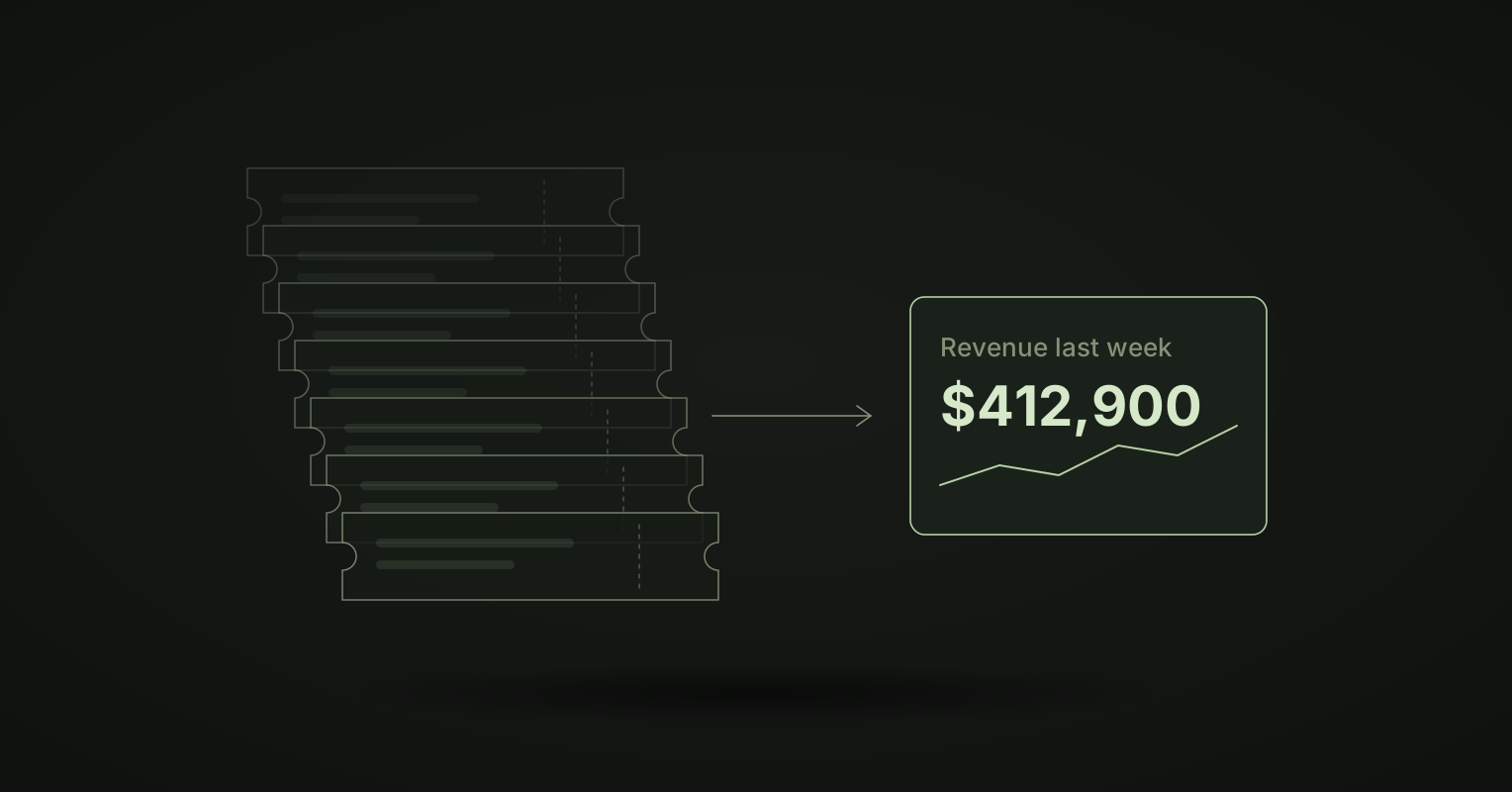
You need one number before a meeting. You open a ticket, or you send a message to someone on the data team. Then you wait. Sometimes it takes an hour. Often it takes days. Sometimes the answer comes after the meeting.
On the other side, the data team gets the same kind of request ten times a week, each with a small change. “Can you split that by region?” “Can you do last quarter instead?” One analyst described ad hoc requests as “one of the biggest headaches for data scientists/analysts”. The team that asks gets frustrated waiting for someone to have time, and the team that answers never gets to the work it was hired for.
This post explains why the queue survives every self-serve rollout, and how Kater lets people get their own answers without making new numbers.
Why self-serve BI did not empty the queue
Most companies already tried to fix this. They bought a BI tool, gave everyone a seat and ran a training. Hex describes what usually happens next: “the backlog of dashboard requests is bigger than it was before”, “most of the licenses barely get logged into, and business users are quietly Slacking the analytics team for numbers.”
There are three reasons:
- The tool asks too much. To answer one question, a person must find the right model, pick fields, set filters and build a chart. That is a skill. Most people use it twice a year and forget it in between.
- People do not trust what they build. If you are not sure you picked the right revenue field, you ask the data team to check. Now it is a ticket again.
- The answer lives somewhere else. People work in Slack, email and chat. A BI tool is one more tab to open and one more login to remember.
So the questions go where they always went: to a person on the data team.
The fix: define once, ask anywhere
The way out is to split the work. The data team decides what each number means. Everyone else asks questions of those numbers, in the place they already work.
In Kater, that split looks like this.
The data team defines each metric once
Revenue, active customers, churn: each one is a measure, declared once in a shared model in Kater SQL. Every query, dashboard, app and agent answer reads that same measure. The data team reviews the definition one time, not every request that uses it.
Business people ask in Slack, Claude or ChatGPT
A business person does not need a seat in a BI editor. They read dashboards and apps in the browser, or ask in Slack, Claude or ChatGPT. With the Kater Slackbot, a person sends a question in a direct message and gets the figure in bold, a link to the result in Kater and the date the data runs to. It needs no Claude or ChatGPT seat, and it only reads. Teams that use Claude at work can also write @Claude in a channel to answer a question for everyone to see.
Every answer uses the person’s own Kater access. So they get the same figure they would get in Kater, and nothing they are not allowed to see.
Explore shows what a model can answer
Many requests start with “what can we even see?” Explore answers that before anyone asks. Select a shared model, and Explore shows its headline numbers, trends, drivers and patterns as cards with real charts. Open any card to change it, then take it into a workspace or a dashboard.
A digest answers the question before it is asked
A lot of requests repeat every week: “How did we do?” “What moved?” A digest is a page your own agent writes on a schedule. It reads the metrics you watch, finds what moved and writes one page about it. It reads only what you can read and changes nothing shared.
What changes for the data team
The data team still does the important part. In Kater, the agent does the typing, and the data team does the judgment.
- Fewer pulls, better definitions. Time goes into the shared model, where one fix helps every answer.
- Repeats become visible. When people keep asking for a number the model does not have, that is a sign to add it. Promotions also find fields that several queries define again and draft one shared definition for them.
- Nothing ships by surprise. Agents read the definitions the data team owns. They do not invent new ones.
What changes for everyone else
- You ask your question where you already work, in plain English.
- You get the figure, the date it is current to and a link to check it.
- You get the same number as the person next to you, because you both read the same definition.
The queue does not disappear because people stop having questions. It disappears because a question no longer needs a person to answer it.
Frequently asked questions
Why do data requests pile up even with a self-serve BI tool?
Most self-serve tools still expect a business person to learn an editor, find the right model and build a chart. Most people do not, so they message the data team instead. The queue moves from a ticket system to Slack, but it does not get shorter.
How does Kater cut down one-off data requests?
The data team defines each metric once in Kater. Business people then ask questions of those metrics in Slack, Claude or ChatGPT, or read a digest their agent writes each morning. Every answer comes from the same definitions, so the data team reviews definitions, not every request.
Do business users need to write SQL in Kater?
No. Business users never write SQL. They read dashboards and apps in the browser, or ask a question in Slack, Claude or ChatGPT.
Does the data team lose control of the numbers?
No. The agent does the typing, and the data team does the judgment. Agents read the shared definitions the data team owns, and an agent acting for a person sees only what that person can see.
Want to see it on your own data? Book a demo, or read how business teams use Kater.