
It is 8:50, and your first meeting is at 9. The number someone will ask about is somewhere in four dashboards, a Slack thread and last week’s deck. You have ten minutes to find it, and to find out why it moved.
A digest does that before your day starts. Your agent reads the metrics you watch, finds what moved, and writes one page: the one thing that matters most, what moved and why, and what to do today. A dashboard shows you every number. A digest tells you which one to look at.
A real one: Sally’s Monday Brief
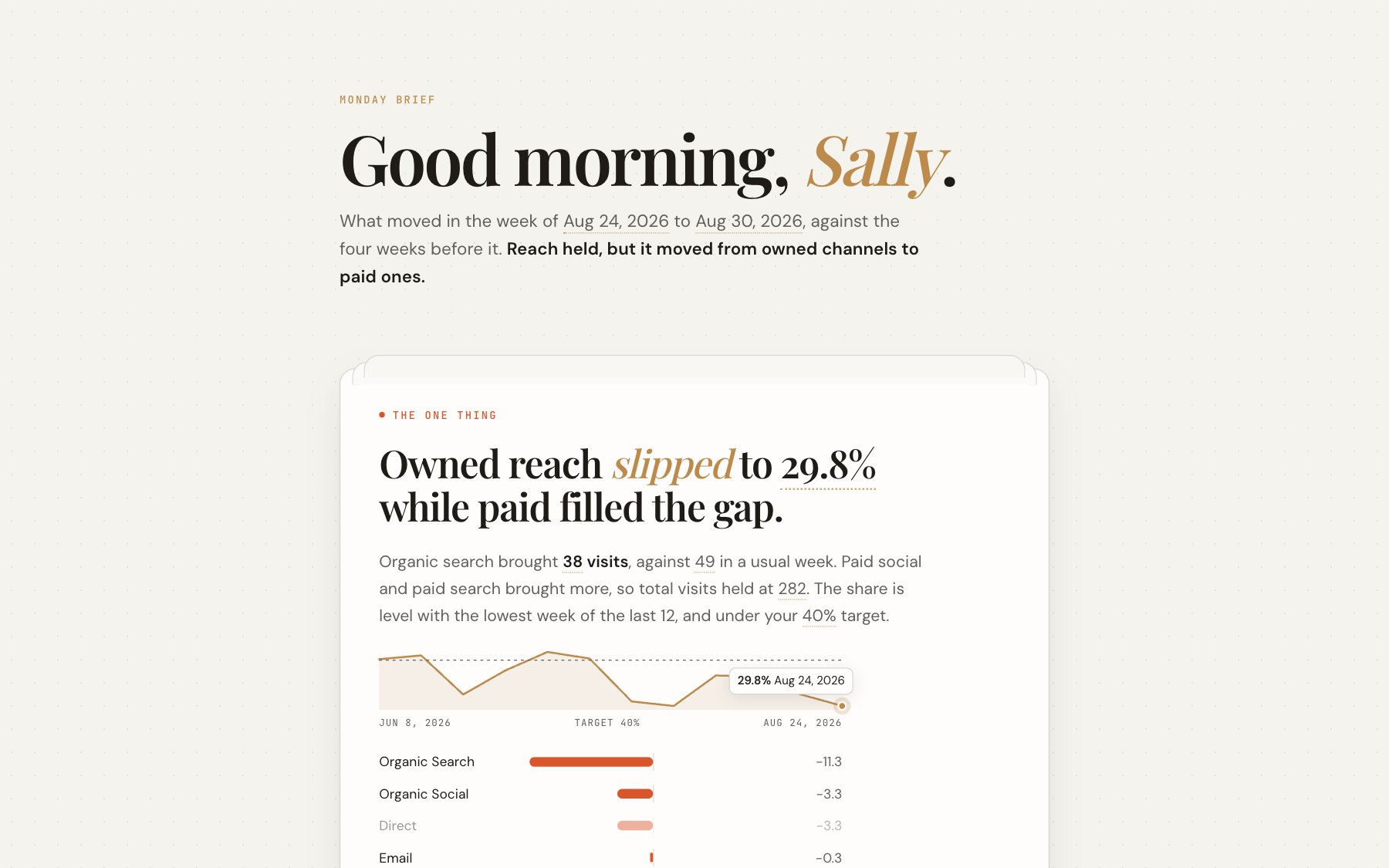
Sally is a lifecycle marketer at ShopTech, our demo company. Last week her total visits held steady, so every dashboard looked fine. Her Monday brief found what the total hid. Scroll it: this is the real page, with real figures from the ShopTech demo warehouse.
Here is what it caught before her first coffee:
- She paid for visits that used to be free. Organic search brought 38 visits, against about 49 in a usual week, and paid social and paid search filled the gap. Owned reach slipped to 29.8%, under her 40% target.
- Email got more valuable. Each email visit was worth $190, against a usual $153, from the same number of visits.
- New visitors did not come back. Only 3 of 966 new visitors from the last four weeks returned, and 347 of the others came first from paid media.
Each one comes with what to do this week, and the starter to run next, such as /deep-analysis Why did organic search visits fall last week?.
What would yours say?
Select your team and industry, then select or type your title. The figures are examples, but each situation is one that a digest catches every day.
The example digest is for this title: VP of Marketing, in ecommerce and retail.
Morning digest
Good morning.
VP of MarketingEcommerce and retail
Meta ads got more expensive yesterday, and email made up for it.
The one thing
Cost per order on Meta ads rose to $41 yesterday, 24% over a usual day.
Spend held, but orders from Meta ads fell by a fifth. Email brought 31% more orders than usual, so total orders held at 1,284.
Next step/deep-analysis Why did cost per order on Meta ads rise yesterday?
In figures
What moved
Creative
Two ad sets on Meta ads that brought 40% of last week's orders are fading. Clicks are down 30% in five days.
Audience
New customers from the Northeast are up 18% for the third day, with no change in spend there.
Retention
The repeat purchase rate for last month's new customers is 9% under the month before.
Today
Moments a digest pays for itself
When the total looks fine. Orders are flat, so every dashboard is green. But one warehouse now ships 8% of its orders late, and the others hide it in the total. The operations lead reads it at 7:45 and calls the site before the complaints arrive.
Before the forecast call. Three late-stage deals have not replied in 10 days, and together they are 18% of the quarter. The sales lead walks in with a plan for each, not a list of things to go and check.
Before a customer leaves. Customers rarely say that they are about to leave. Their usage drops first. The digest names the accounts whose usage fell 40% in two weeks, while there is still time to call them.
When a definition changes. The data team fixes “active accounts”, and 14 dashboards drop 6% overnight. The data lead tells the readers first, before the CEO asks why.
Before the month closes. A test environment left running, a bonus that did not stop, a promotion that pays double points. Finance sees spend at 31% over plan with 10 days left, not at the close.
The morning after a release. Checkout completion fell only on mobile web, at the address step. The product manager sees the platform and the step on Friday morning, and rolls back before the weekend.
Set up your own
-
Connect your agent to Kater. See Connect your agent.
-
Tell Kater what you watch. Add your metrics under Metrics I watch in your About you, or run the Update About you starter.
-
Copy a prompt. For a weekly brief like Sally’s, open Monday Brief in the Library and select Copy prompt. For a digest of your own, copy the prompt from the picker above, or run the Weekly digest starter:
/digest Set up a weekly digest every Monday at 8am. -
Paste it into your agent’s scheduler. Claude Cowork, Codex and Cursor can each run it on a schedule. The Library entry has the steps for each one.
Your digest runs in your own agent, reads only what you can read, and changes nothing shared. Every figure on it is live, so when you open the page again, it runs its queries again.
Read more
- Monday Brief: the scheduled workflow behind Sally’s brief, and its prompt.
- Scheduled workflows: schedules, time zones, and how to change or stop one.
- Reports, decks, threads and briefs: the other pages your agent can write.
- The Library: more apps, dashboards, workflows and prompts to copy.